Bitcoin
Bitcoin Worth Zero, says ECB

The European Central Bank (ECB) recently published a blog post cynically arguing that the fair value of Bitcoin is still zero, despite the wildly successful launch of Bitcoin ETFs (exchange traded funds) into which investors have poured billions of dollars, and Bitcoin breaking $1 Trillion in market capitalisation
Euro losing value; Bitcoin goes up!
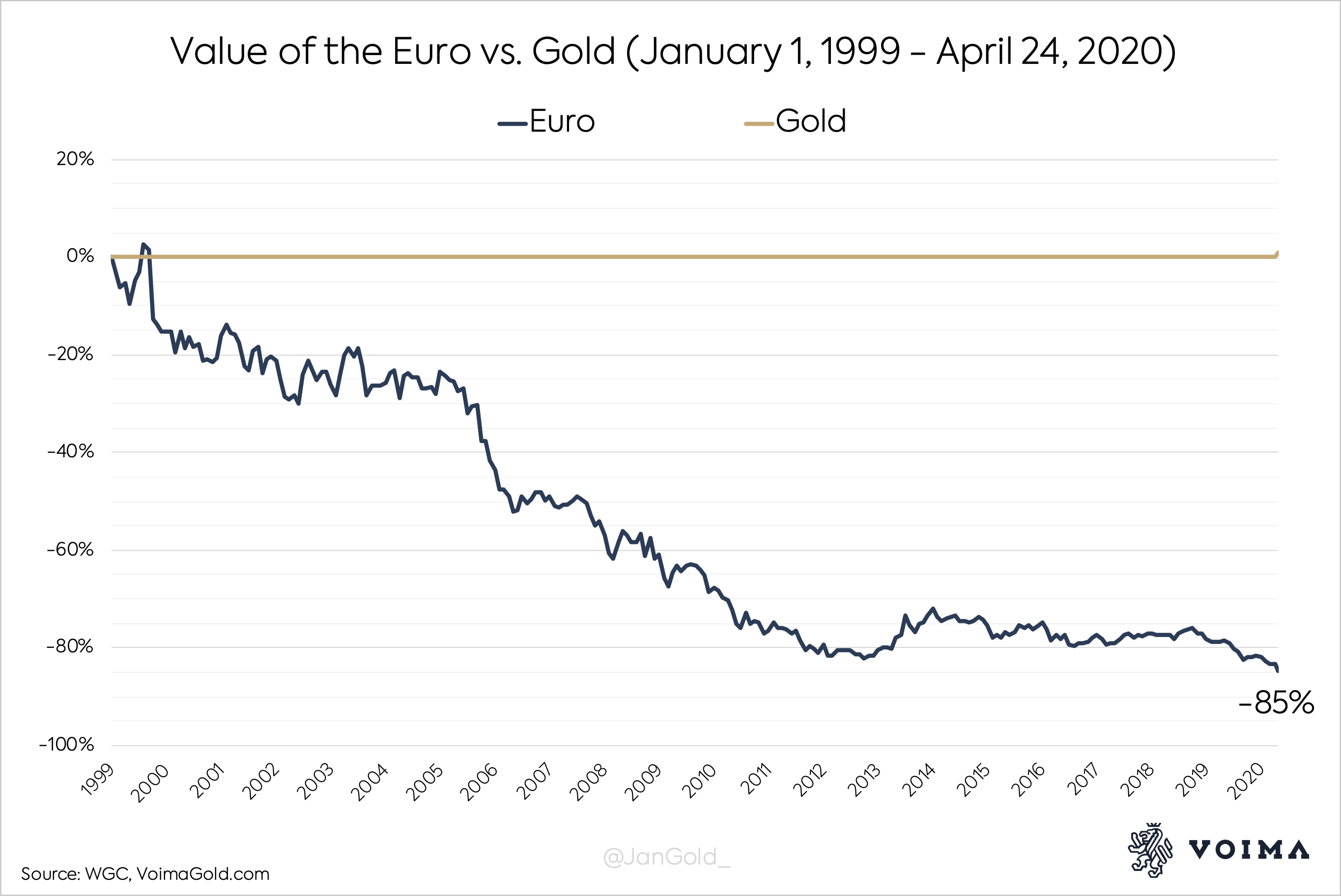
Perhaps confused by the direction of its own currency, the Euro, which has been eagerly heading towards zero vs Gold ever since its launch in 1999, losing 85% of its value in just 20 years.

The post, written by ECB staff member, Dr. Fabio Panetta, claims Bitcoin lacks the fundamental attributes of a currency and that its value is based solely on speculation, never mind that ALL investments are a speculation on their future values, as the future remains unknown.
Panetta argues that Bitcoin’s value is not anchored to any tangible economic good or service, and falsely claims its supply is not fixed, but can be changed by a decentralised network of computers. This is patently false and can be verified in the Bitcoin design within the whitepaper and also within the code.
He also notes that the recent launch of Bitcoin ETFs has not changed the fundamental nature of Bitcoin (yes, we know!) and that investors should be cautious when investing in such assets.
Here he makes a couple of errors.
Investors should be cautious when investing in any asset and Bitcoin is no different, of course. But he also fails to mention that Bitcoin has outperformed all major asset classes since it’s launch, and in 7 of the last 10 years.
Bitcoin is not a bubble!
Here’s a chart showing the full history of Bitcoin’s price. This is not a bubble. It’s an adoption curve. A “bubble” does not recover from 4 bear markets to make new highs. Central bankers continue to ignore this because Bitcoin is anathema to them.


The ECB’s stance on Bitcoin is in line with most major central banks, who have also expressed skepticism about the value and risks associated with cryptocurrencies, including the US Federal Reserve, the Bank of England, and the Bank of Japan.
The popularity and price performance of Bitcoin is a direct vote of no-confidence in central bank policies. It’s not wonder central bankers hate it.
It’s all about liquidity
People buy Bitcoin as a hedge against monetary debasement. Just look at this chart by TechDev showing Bitcoin literally moving with the global liquidity cycle. Every bull market starts when the global liquidity goes up ie when central banks print more money!


Despite the ECB’s skepticism, the popularity of Bitcoin continues to grow with investors as persistent inflation and rising distrust of authority fuels doubts about central bank competence and government fiscal profligacy.
Many investors see Bitcoin as a way to hedge sovereign risk, diversify their portfolios, and potentially earn high returns as global adoption continues along the technology S-curve, similar to other groundbreaking technologies like the telephone, television, internet, smartphones etc.
Number go up!


The market capitalisation of Bitcoin has grown to over $1 trillion, and the cryptocurrency has become a popular investment option for many individuals and institutions. Global fund management giants BlackRock, Fidelity, Franklin Templeton, ARK Invest are now promoting Bitcoin to their clients. Wall Street and trad-fi are catching on. Central banks continue to lag, because the success of Bitcoin questions their competence, and undermines their existence.
No wonder they hate it!